
Fisho's Weekly Fishing Report – 20th February, 2026
by Fisho's Tackle World Hervey Bay 20 Feb 09:30 UTC
20 February 2026
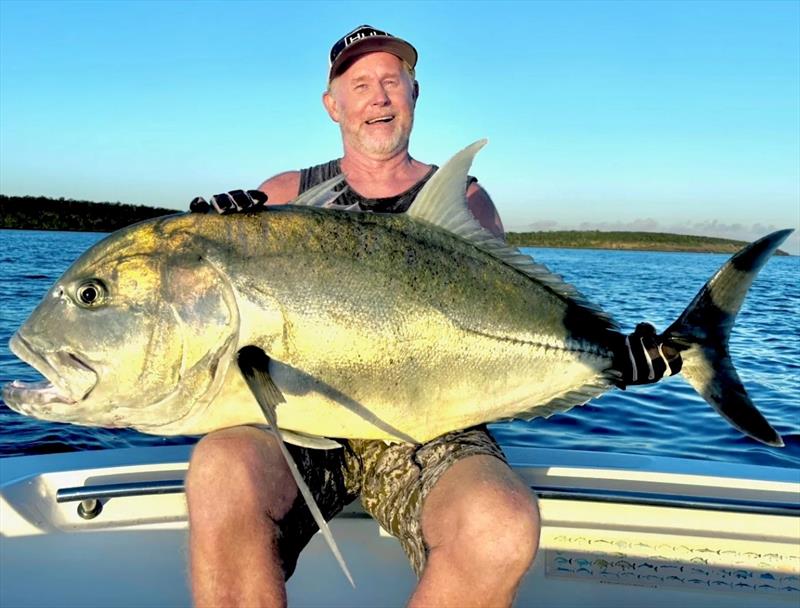
Dave Howe had his hands full with this monster inshore GT. Catch 'em while you can, as they won't be here forever © Fisho's Tackle World Hervey Bay
A dry week after last week's drenching
Contrary to what the BOM had forecast, we copped an absolute drenching here in Hervey Bay last Friday. If there was one place in the southern half of the state that the rain forecasters said would see the least, it was us. Yet, down it came, big time, and the radar at the time showed vastly less precipitation for those to our north or south. Wow! Will they ever get it right?!
Widespread rains did eventuate throughout the weekend that saw cumulative totals spike pretty much everywhere across Queensland. The coast copped the most in our region, whilst our river catchments caught very little by comparison. A great net result in a way. Renewed vegetation (including our lawns) and a burst of fresh to reinvigorate our local marine life, without extended riverine flooding.
It got a bit windy whilst this rain event unfolded, and cooled dramatically thereafter, which was nice. It has warmed up again now and will get warmer this week as light-moderate onshore winds increase the humidity once again. After a brilliant day yesterday, those out on the water today are bouncing around in a 10-15 knot easterly that sets the stage for the weekend.
Saturday and Sunday are both looking half decent for boaties planning a trip locally or up the island, but you had better check the latest forecasts before heading out. Some sites suggest less than 15 knots from the east to south-easterly at worst, whilst the BOM says 15-20 knots. Similar conditions will kick off the working week before the wind cranks up another notch from the south-east.
It should be largely dry for the most part all week, or at least until a few isolated showers are dragged ashore later in the week. The passing of the new moon yesterday means the moon is waxing once again, whilst daily tidal variation diminishes for the coming week. Draining tides such as these will trigger a response from predators out in the bay and down the straits, whilst also creating fresh opportunities for flats fishos and landlubbers.
Local rains and where they fell
As intimated above, the heavy rains that fell over our district last Friday were very much constricted to the coastal strip. Our local hinterlands received a decent portion of what we did closer to the beach, yet it wasn't enough to trigger any form of real flooding. Parklands and local waterways in the Hervey Bay township were overflowing from the torrential downpours Friday. Certain localised falls far exceeded the numbers recorded in official gauges according to regulars sharing their insights as the wet weekend unfolded.
To rattle off a few stats from the Qld government's "LongPaddock" rainfall recording site, the local numbers for the past week for our district look like this:
- 183mm Hervey Bay Airport
- 178mm Ghost Hill
- 148mm Black Swamp Creek
- 146mm Takura
- 111mm Torbanlea
- 99mm Howard
- 133mm Wal's Camp (Pacific Haven)
- 140mm Lenthalls Dam
- 125mm Upper Cherwell River
- 110mm Gregory River
- 103mm Maryborough
Some of these stats may suggest falls in the hinterlands that were significant, but the reality is that their rains fell over the extended period into the weekend, as opposed to the substantial downpours that bombed the coastal strip Friday. Great rains either way you look at them, with the added bonus of minimal riverine flooding. All local rivers have a fresh taint, but are all currently deemed "below flood level".
Localised run-off Friday was quite dramatic, whilst also being isolated and variable from one suburb to the next. It seems as though Urangan copped the most rain Friday (some say as much as 200mm that day alone), whilst the Torquay-Scarness strip wasn't far behind. Local parks were awash and all water mitigation channels flowed strongly, yet major flooding was avoided. Such is the advantage of coastal rains that escape to sea very quickly without protracted mainland flooding.
It would be nice (and advantageous) to have official rain gauges positioned at our coastal extremities, so that we coasties get a feel for the reality of local falls on top of what is recorded at the airport. Gauges at Urangan Harbour, Pt Vernon, Burrum Heads, River Heads, Kingfisher Bay Resort, Waddy Point etc for example. Or is that data available and this old scribe is too limited in online scrolling ability to find it?
Chance to capitalise on local run-off
Going fishing in pouring rain is certainly unappealing. Yet, such rainfall creates wondrous opportunities to fish for prime species such as mangrove jacks, barramundi, jewfish and queenfish like few other events. No doubt most everyone sheltered from the worst of the rains, whilst a savvy few raced for the drain-offs and overflowing pondages and waterways as soon as they could thereafter.
You had your chance to target predators drawn to storm water outlets spewing freshwater across the beach. It may have only been pesky sharks and the odd stray flathead, or it could have been queenfish and large grunter working the fringes beyond. Events that surge such watery excess into our beachscape create a very limited opportunity, so timing can be everything.
Suss out the rock groynes at Shelly Beach or the stormwater pipes that cross Torquay Beach the next time a deluge like this eventuates. Then, once that surge dissipates, spread your own efforts and wander the local area looking for displaced baitfish that will attract predators, along with the likes of whiting, bream and grunter foraging for morsels washed from the land-locked lakes.
Better-still, head for the local pondages scattered throughout Hervey Bay and beyond. Man-made lakes that back onto housing estates join other waterways in providing ample opportunities for landlubbers to tangle with hyped-up estuarine predators triggered to feed by the rain-borne abundance. Jacks and barra are the two primary target species, and boy oh boy don't they fire up!
Rains trigger major bite from our jewfish
As many of you will know, jewfish are another species that responds very favourably to major rains and flooding events. The response from the local jewfish population this week has been dramatic and very productive for local fishos, even though major flooding didn't occur.
Local rock walls are a hive of activity day and night as many hopefuls get wind of the jewies on the chew. Some use live baits and some even catch them with dead baits, but it is those chucking lures of one type of another that are having the most fun. Jewfish biting so well are absolute suckers for a host of well-presented artificials that include the usual line-up of soft plastic paddle-tails and prawns, hardbodies and soft vibes. These times also offer nocturnal or pre-dawn fishos the chance to crack a jewie on topwater, so opportunities such as these should not be ignored.
River Heads has come alive this week too as the jewies aggregating in the area position themselves to pounce on baitfish displaced by locally heavy rainfall. Regular readers won't need to be reminded that it is shallow-diving hardbodies like Bombers and B52s that have the runs on the board from the past, whilst newer alternative hardbodies also create the right commotion to attract a River Heads jewfish.
Casting paddle-tailed plastics has worked in this scenario since their inception eons ago. Ultra-realistic soft prawn imitations that modern-day fishos have access to can take this fishery to the next level for those that don't need to 'feel' their lure working. Again, topwater opportunities abound down there at the heads, so if it is a topwater jewie that you are keen to tick off, then maybe you should be down there when the tide is out instead of sitting at home wondering.
It isn't just jewfish you might encounter whilst fishing lures at River Heads. Barra are once again on the hitlist and regularly visit that peninsula. You might get lucky and trip over barra first try, or you might need to put in the hard yards like some of us did so many moons ago. The same lures the jewies swipe at will catch the barra, and they will catch flathead, threadfin salmon and their cousins the blues too. In fact, blues become a very real topwater option, particularly for those that wander away from the point and along the shallower muddy verges nearby.
Status quo unchanged for local reef fishos
Last week's rains were a bonus on all accounts for our local fisheries and will hopefully trigger a favourable response from our inshore reefies. Sweetlip remain abundant and will bite even better now. Squid baits remain the preferred baits for many folks, though there are fans of hardy heads out there that swear by those locally-caught baitfish.
To be honest, sweeties are a real "garbage guts" that will eat a huge range of morsels, from crustaceans and molluscs to fish baits and select lures. Their pointed snout and gnawing teeth even enable them to tear at the carcasses of larger deceased marine creatures such as sharks etc, so there is no need to get too fussy with sweeties.
Hopefully, this taste of wet season rains will trigger an inbound migration of our nannygai. You can cruise just beyond the banks or further up the bay and find a few no doubt, but it is yet to be seen if any numbers migrate into our local shipping channels like they do post-wet some summers. Pencil squid attract nannies, like they do so many other species, so their movements can dictate just where the nannies may settle. Local artificial reefs are a good starting point if you don't have history catching nannies, whilst certain more isolated and less fished grounds elsewhere will be even better.
Coral trout and estuary cod continue to bite ravenously, and there is no need for this to change any time soon. Try the shallow reef country whilst the tides still have some pull, or resort to the deeper inshore reefs over the neaps. You have some fancy new soft plastic prawn imitations to offer them these days that resemble the tried and well-proven varieties we've all been using for years. Pre-rigged options with various head weights attached to the gun colours are just one option, whilst much larger prawn imitations might be what it takes to tempt warier fish so used to the 5-inch models so popular to date.
Fishing our deeper inshore reefs is not without its risks or potential frustrations. Sharks continue to be the main hassle, and they are getting worse. Try to avoid them if you can, and please don't park-up feeding them quality fish one after the other. I am repeating myself, I know, but once again this week, I had to listen to a fisho sharing a yarn about his day on the water with a local 'gun' that saw 30 fish destroyed by sharks in one location. Devastating!
Big giant trevally continue to add their own style of challenge to the local reef fishing scene. They are still lurking around our inshore shipwrecks and other artis with evil intent. Your little reef fish or mackerel might be the next thing they scoff as they dominate their temporary abode. You only have the summer months to tangle with them if that appeals to you, so make the most of future opportunities and you should enjoy some hard-pulling heart-pumping action.
Tuna joined by spotties in Platypus Bay
Our tuna season seems to have properly kicked off thanks to finally getting a decent south-easterly breeze or two in recent weeks. An ever-increasing biomass of school longtails is making the waters of Platypus Bay their own, and you wouldn't be a little baitfish up there for quids. The tuna hordes have drawn the attention of the bull sharks and some of their cousins, but thankfully, there are schools busting up everywhere, so finding tuna without attending noahs has been possible.
In fact, the school LTT have been joined by a late-season run of spotted mackerel, which has been a delight for those fishos that discovered this bonus in recent days. You have the option of joining the fun up the island this weekend whilst the wind is from the east, so pack the spin outfits, plenty of metal slugs, jerkshads and stickbaits and head on up for a look.
The tuna shouldn't be too hard to find. Just scan the horizon for cartwheeling birds whilst you travel and steer towards any likely bust-ups. Those familiar with differentiating the spotties from the tuna will likely take advantage of a handy feed of mackerel too, whilst those still learning may trip over the spotties if they luck out. Regular readers will know the tips shared in the past, so I won't get too carried away again now. Suffice to say; spotties sip at the surface and don't leave the water whilst tuna surge out of the water frequently. Their colouration is a dead giveaway when close enough too.
Spanish Mackerel fans can catch them next week
The first of our two annual 3-week long Spanish Mackerel closed seasons is just about concluded. Come midnight of the 21st of February you are permitted to target and retain your quota of spanish mackerel. It won't take long to fill that quota; it being a paltry one fish (or two per boat if two or more fishos on board). The abovementioned closure refers to the 'Southern Waters' south of say Stanage Bay. It is totally different dates north of there.
Remembering that the second 3-week closure will commence 1st March and run through until the 21st inclusive, you have a week to have a crack at a spaniard. Sadly, the weather isn't perfect for such a caper, but it is within reason that even small boat owners can catch them inshore if the breeze stays sub-20 knots. Given that Platypus Bay is a year-long no-take zone for spanish mackerel, the easterly winds and Fraser's protection up the island won't help spaniard fans this week.
A troll across the banks or even past the shipwrecks of the Roy Rufus or the Simpson might see your drag squealing and your reel losing line at an alarming rate. Spaniards may not be the only culprit responsible for the lost line, as broadies and schoolies are also in the area and those big old GTs are partial to trashing lures meant for mackerel too. Get some stickbaits dancing across the surface if you believe you are in the spaniard zone, or kick back with a live bait suspended mid-water adorned with a set of gang hooks. Either way, your efforts will hopefully be rewarded and you are dining on fresh mackerel that evening.
You could follow the lead of so many other mackerel fans and try the you-beaut Reaper Rigs that are so popular these days. These pre-fab rigs simplify bait-rigging for mackerel and enable you to present a range of baits from a humble pillie or garfish to a larger bonito or legal-sized schoolie. A slow troll across likely grounds at dawn would seem a good idea, and again, it might not just be the spaniards that like your offering with so many greedy old GTs in our waters.
Our rivers avoided flooding and continue to fish well
Estuary fishos were indeed blessed last week when the heaviest rainfall fell along the coast and avoided the river catchments. Both the Mary and Burrum systems have a taste of fresh, but neither are in any way flooding. Water quality remains good, but is varying, so be prepared to burn a little extra fuel if you find waters unappealing in a chosen stretch.
The Burrum's barra and mangrove jacks continue to bite well and some magnificent fish were caught up there this week. Threadies continue to be the bonus species for Burrum fishos, as they rebound since gillnetting effort was reduced. They were always caught in that system by those in the know each and every spring, but were hard to find for obvious reasons later in summer (when netting was still permitted). Happy days now for Burrum fishos as all species thrive in an environment that has recovered dramatically. Abundant baitfish, prawns and their predators are all part of a very healthy river system that we can hopefully enjoy for the foreseeable future.
It is all about barra and threadies in the Mary system at present, and will be even if more serious rains come. The fish are ready for flooding this time of year and are built to adapt and thrive in such conditions. For now, though, it is a simple enough matter of scanning for fish in likely haunts and offering them soft vibes, prawn imitations or proven hardbodies. Trollers can get their troll on over these draining tides this week too and expect action without traveling too far upstream.
Both river systems are hosting quality grunter and no doubt a sampling of flathead. Blue salmon are more common down the Mary and throughout the straits, but they too frequent the Burrum. Jewies are being caught shore-based at River Heads, so that should give you boaties ample hint to try nearby rocky outcrops and deep holes. The same applies for the Burrum jewies that just might be on the chew in some of the well-known deep holes in the lower reaches.
Muddies on the move as prawns grow fatter
Nothing like heavy rains to get the mud crabs on the march. Local crabbers have been revelling in the temporary abundance this week apparently. Quality bucks hunted from their backwater holes by the scent of freshwater and localised run-off (and in the knowledge that the jennies will now be receptive to their advances) have slipped into the mainstream flows of many of our streams and are potting regularly. A lack of actually flooding means they are largely still within the streams, so finding a few should be pretty easy. Well... should be, if there wasn't so much non-local commercial crabbing effort hereabouts of late.
Local rains are a godsend for prawners who can look forward to the local prawn population growing fatter quicker with slightly less saltwater to exude from the bodies. They expend a lot of energy doing so, which is why they grow so fast in our brackish backwaters when they are small. Some may have gone to ground temporarily this week, but they will re-emerge.
Get the top pocket cast nets ready folks, as our prawn season proper is about to kick off. We haven't had a season showing as much promise as this year for a while, so great things are expected from the local prawn scene from now right through autumn. Future rains and flooding events will mould our prawn season, but for now, it is game on in our rivers, with the Burrum the first to fire and the streams to the south thereof being next.