
What the Firefly means to me - Steve Tylecote
by Steve Tylecote 4 Sep 19:00 UTC
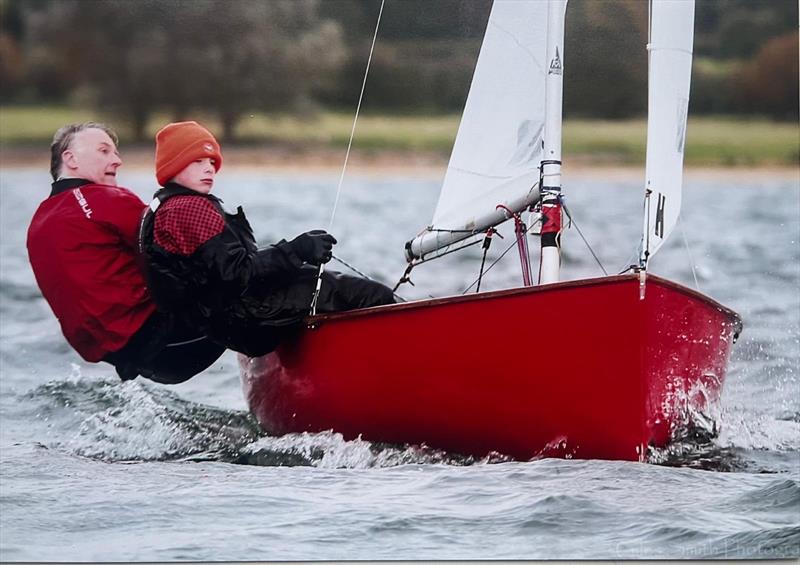
Steve and Jamie in Grasshopper in the Inlands at Rutland © Giles Smith
As the Firefly class sails into its 80th year - still going, still beautiful, still impossible to give up - we're sitting down with a few class legends to ask the big questions: why do you keep coming back, and what does this stubborn little boat actually mean to you?
This time it was Steve Tylecoate: team racing royalty, Firefly stalwart, and owner of a fleet large enough to require its own harbourmaster. He was joined by his wife Fiona, who intervened swiftly and repeatedly to set the record straight.
I should confess I arrived with baggage. When I first started sailing Firefly's, the rumours about Steve came thick and fast. "Fiercely competitive," people said. "Difficult," someone may have muttered. None of it was true. Admittedly, relations improved considerably after I accused him of rocking in a light-wind race at Tenby, to which he bellowed back, "I am just adjusting my centreboard, mate." Ever since, I've found him unfailingly generous with his time and great fun to be around. His fancy dress has always been on point.
Steve's whole approach to Fireflys, to team racing, and to sailing in general comes down to one thing: getting people into boats. He, Fiona and a band of Rutland Stewarts somehow delivered thirty different people to the Nationals at Tenby. He does a great deal of blind sailing, and has quietly done more than most to open our precious sport up to anyone who fancies a go.
And while his beloved Grasshopper is, let's be honest, an acquired taste to look at, it has always gone - and continues to go - alarmingly fast. Steve literally wrote the book on team racing, and has done an enormous amount to professionalise, train and drag people into that side of the sport.
For my part, I thoroughly enjoy racing against Steve, his children, his children's friends, and his armada of eleven (eleven!) Fireflys. I hope to see the entire flotilla at the Inlands at Rutland Sailing Club, Sat 19th - Sun 20th September. Enter here.
Now, over to Steve!
My first awareness of the class came long before I ever sailed one. I was reading Eric Twiname's Start to Win, poring over those amazing photographs of admittedly quite old Firefly's being sailed rudderless in howling conditions. Wooden boats, steel boards, stiff masts, and someone steering with nothing but heel and trim. It caught my imagination, and I would love to know more about those pictures if anyone can shed light on them. I still think rudderless sailing is a wonderful skill.
The sailing itself took a while longer to arrive. There were no Fireflys for me at university, where it was all Larks and Laser 2s, and in my travels around the uni circuit I never once came across a fleet. It was only in the autumn after I graduated, in 1988, when I stayed on to work in Southampton, that Greg Ansell at Spinnaker recruited me. Ken Rowles was the Commodore then, quite a big character, though not especially a Firefly advocate. Greg most certainly was. I turned up to sail my Laser in some club racing, looked at the one or two Lasers going out and the fleet of five or six Firefly's beside them, and Greg said, 'Do you want to borrow one?' It looked more fun. I went. I was 22, and that was that.
The world I had wandered into took some getting used to. The class in those days had its bring-your-own-boat team racing events and a large post-uni team racing circuit: the RNVR, the Budworth Pairs and the Foot Trophy among others. You took your own boat to those to sail alongside the open meetings, or, more likely, you took Greg's boats, because ownership at Spinnaker was always a bit loose. Much of our energy went on foraging for boats, which had to be wooden because there were no plastic builders at the time. Spinnaker, it turned out, was an oasis of activity that was not really happening anywhere else, and it drew people in.
The people it drew were formidable. At a Nationals you would come up against the likes of Dave and Nikki Derby, Steve and Liz McQueen, Johnny Ellis (David Ellis's bigger brother), Robbo at West Kirby and Ricky Tagg. There were plenty of hotshots about, many a little older than me, and many of them had sailed Fireflys all their lives at stalwart Firefly clubs like Rickmansworth, Itchenor or West Kirby. That was never my story. I had simply arrived at Spinnaker as a fresh graduate and been handed a jib sheet.
Foraging soon turned into owning. In about 1989, somewhere like Bournemouth College was shedding a fleet of old, knackered wooden boats. I got a couple and kept one, which I called Babar. She was done up over a winter in the lean-to of my rental house in Southampton, using epoxy liberated from a shipyard where friends were working. God knows how we got it to go off, but it put her on the water, even if it was not the finest restoration. The deck was collapsing around me as I team-raced her, and I remember throwing a bit of it at one of the Castaways' sailors, which felt pretty good at the time. The boat was quite literally shedding weight as she went round the course. Not long after I turned up at Spinnaker with Babar, Greg got hold of her and redecked her in his shed, between patients, and that saved the boat.
Babar taught me enough to try again, and in the early 90s I did up another one, Grasshopper, the boat you still see me in today, sourced from a barn at Cromer School. I should mention here that I failed my woodwork O level, and people who have seen Grasshopper are not surprised: there is a lot of glue in her, and epoxy was my saviour. I was working in retail at John Lewis, which meant Mondays off in the days when society believed in a five-day week, so I got in much deeper on the construction side. The centreboard case came as a kit from Knight and Pink, who had been builders briefly but by then operated out of Hill Head Chandlery, with a works in Titchfield where they primarily made coffins. So off I went to the coffin factory and collected my centreboard case.
There were no half-made Fireflys lying around by then, which was rather sad, but the class at Spinnaker was only getting busier, and at times it felt as though more than half the fleet at a Nationals had come from our club. Everybody was building boats, finding fittings on the cheap, hunting down a decent mast and an alloy plate, and when you collected a boat you left the steel plate on the grass, much to the disappointment of the seller. Grasshopper, I am told, I once described as my true love, and that is probably right, although Fiona has sanded her bottom on more occasions than I care to mention, because whenever work is needed I tend to become ill, usually about now, just before the Nationals, and Fiona has to take over. She has suffered for the cause in other ways too. I should record for posterity that Simon Spolton, an innovator with boat spray filler, once sprayed Fiona's car along with his hull, the car being parked downwind of the boat because spraying had to happen outside the garage, and it had a dappled bonnet and spots on the windscreen from then onwards.
Boats were only half of it. As I became more involved in the class, I took on the role of social secretary, with the legend that is Guy Davison as my mentor. My responsibilities included ringing the results through to the Telegraph at the end of each day of racing, arranging the sports night at the Nationals, the Dinghy Show exhibit, and the infamous Firefly Christmas Party, plus any other tasks my mentor allocated to me. All the while, the team racing was there. We were building a Spinnaker team, and the idea simply rolled on with time, always with an element of Southampton people in it, and there was an automatic link from uni into the fold at Spinnaker if people wanted it.
It was a more ad hoc world then. You did not have to be in a set team or enter in advance; you just turned up with whoever you had, and Peter Barton and I shared a place on a team for about a year on exactly that basis, Pete being an estate agent who worked Sundays while I was in retail working Saturdays. In the early nineties, though, we started getting better, largely because I stopped my weekend work and sailed a great deal more.
A turning point came at the Budworth Pairs in 1993. Fiona and I were the two helms, Mel and Tash were crewing, and it was howling, to the point that the girls made their own rule that they would not cleat the sheets, to avoid the risk of a capsize. We beat Roger and Greg in the semis and went on to win against a strong West Kirby team in the final. I think it was the first time we had beaten a West Kirby team, and from a results point of view we never really looked back. We moved our focus to preparation and performance, videoing our training with a camera that weighed a ton, holding tactics sessions in the pub, but generally just having a lot of fun. From then on it felt as though we had the upper hand slightly. It was about then that umpiring came in.
That new seriousness found its target soon enough, because the first ever IYRU Team Racing Worlds was announced for 1995, and once we knew it was happening, it became the focus. Critical to that whole era was the design and production of the Porter boat, a side alley that has never had a fair mention in most people's chronology. Without that plastic one design, accomplished through collaboration between the Class Association and Porters and brought out just in time, the Firefly fleet at West Kirby would have perished, because my God it was falling apart. It was a bit like my Babar, with bits coming off as you sailed around, and it was not uncommon to finish a race rudderless. Without the Porter boat I do not think there would still be Firefly's at West Kirby, and the fleet could look very different today. I went along to Porters with Greg Ansell, who was instrumental in the whole process, and we saw a lot of ribs being built, all a little industrial and heavy, but the boat filled the gap and kept the class alive.
We won that 1995 Worlds: me and Mel, Greg and Tash, Roger and Damian Boreham. Soon after, Fernhurst asked me to write the team racing book, UKTRA was formed and umpiring was fully established. The same year brought my first Nationals win, at Weymouth, launching from the old Castle Cove into the harbour and sailing outside through the breakwater. Castle Cove involved getting your boat down a sort of cliff path, seriously, so it was teamwork even to reach the beach.
I had turned up to that one not particularly organised about a fleet racing crew, and on the foreshore I met Jo Burchell, as she then was, who introduced herself and explained about her dislocating shoulder, and that she might have to shoulder barge the mast, but if she timed it right with the wave it would be good. We sailed together that week, and we are still very close friends. Jo, who is Jo Spolton now, later exacted a curious revenge for whatever I put her through by holding her wedding on the Friday of a Nationals I happened to be leading. It was an absolute pleasure to attend, but really, what sort of behaviour is that, holding a wedding during Firefly Week, especially when your other half is the technical secretary of the class.
Jo is rather symptomatic of the people this class attracts. I tend to sail with people who enjoy their sailing a lot, but who are also up for enjoying the event and the socials as much as winning: competitive, but not to a fault, and I probably need that moderation in the boat. I was once so busy making sure my crew Emma Gage was having a great time at an event that Fiona tipped a pint of beer over my head, which was memorable.
Others brought a harder edge. Mel and Tash, who were in the Worlds team, were, and are, tough as nails, the sort who could take down an American team single-handedly and still sail the next morning. Then there were the Sallys: Sally Cuthbert with her five Youth World Championship sailing golds, and Sally Wilson, who has won the Nationals more times than anyone else, although her most memorable Nationals I believe is still Abersoch, and the large amounts of sand she had to bail out on the way to the start every day, Grasshopper's primary role that week being a beach hut for the boys' toys. All big characters, and I have had good times with every one of them.
Not every memory from those years is comfortable. The standout structural failure came in the second to last race of the 50th anniversary Nationals at Restronguet in 1996. It was howling, and Mel and I had a rather comfortable lead, as was the way when we were young and fit enough to hike, when the rudder blade snapped rather catastrophically. We got back to the shore alright, but with two races on the last day and only one discard, that was the end of our event, which was a bit disappointing.
I still get cold sweats about a tacking battle in a Gore, though I honestly cannot remember which one. We rounded the last mark with Barney in the lead and me two boat lengths behind on a short final beat, and I remember thinking how pleased I was for him, because his dad had been massively helpful to me finishing off Grasshopper. But a tacking duel is what we do in these situations, the team race training coming out, and at about tack number seven there was a bit of a mainsheet moment for Barney and we got through. I felt horribly guilty, and it has stuck with me. I remember the incident vividly and cannot remember the venue at all.
Another difficult moment came at Abersoch, where, despite the massive white horses out in the bay, my event buddy and his crew were preparing to launch in yellow oilskins, with a steel plate, brass everywhere, no buoyancy bags and World War One buoyancy aids. I honestly felt they were going to die, and as their newly assigned buddy, I felt an obligation to say something along the lines of: "Hi, I am your buddy, I am really pleased to meet you, but please do not go sailing." It felt bloody awkward, but I managed to convince him it was no joke, and he lived to sail another day. It should be noted for posterity that in those days it was necessary to sail with two full-size buckets in case you capsized, and that if the bags were a bit low on air, the bailing sometimes had to be done while floating outside the boat.
Meanwhile, the team racing was becoming properly organised. At Spinnaker it was always a meritocracy. You did not get in the team just because you were good mates, or, as Fiona says, sleeping with the captain. You needed a good boat for team racing, and you needed to get a top ten result at the Nationals or equivalent. Equally, you didn't stay on a team just because you once won a Worlds. That was the era when Hud, Dom and Owen Modral got involved in the Spinnaker stuff, along with Nigel Wakefield and Colin the American, all part of the squad training. For a while we had two balanced teams operating out of Spinnaker, and we trained a great deal, mostly because it was more fun going training with your mates than trailing the boats around to events. Sometimes we could not find UK teams who wanted to sail quite as often as we did, so the Dutch used to come over and sail with us for weekends, and the Irish a bit too.
Those years supplied their own comedy. Fiona's team once protested mine because we were still drinking tea on the bank when our race was due to begin, and the start boat held the racing until the Spinnaker team, us, reached the start line. Fiona was not happy, and I ended up witnessing against myself, which was an interesting position. The racing areas could be just as odd. One of the more peculiar was at Lymington, in the backwaters around the marshes, where the tide went out during the event and turned the course back into marsh, so we had to walk our boats around the windward mark. As a Firefly fleet, I think we were rather good at it. We identified the order in which we were arriving, proceeded around on foot accordingly, and carried on down the run. You have just got to chuckle.
People sometimes ask why the Firefly won out, considering that at one point Laser were giving us Laser 2s for free. A whole set arrived at Spinnaker, plus spares, so keen were they for us to use them, and yet we carried on in these old wooden boats. I think the Firefly is uniquely suitable. All that rocker means it can take almost any combination of crew weight, medium, large or small, so it is very forgiving, and the gender balance in the class is better than in most of its competitors, which counts enormously in its favour. It is robust and manoeuvrable, with an appropriate sail plan.
It has also managed to stay traditional whilst modernising, which is a difficult balance. We used to sail with spoon rudders and transom mainsheets, and in honesty I had no issue with either, but if the class had kept the steel plates, the heavy rigs, the low booms and the closed-in Mark 1 cockpits that cramped the crew, other classes might well have come through. As it was, once Rondar got involved, the boat really started to penetrate the university market, and it is worth remembering that for the builders the universities are the dominant market. However much we think about the Nationals and our fleet racing, the money for the builder is driven by team racing and its reach into the universities, the schools and the clubs.
That reach is really all about pathways, although it rather looks after itself when a club gets things right. If you can link together the youth, the students and the adult sailing at a club, and team racing and Firefly sailing as a whole are great ways of doing this, you soon realise that it all becomes a mush of people sailing together. The adults are not all better than the students, and the students are not all better than the youths, and that mixture is exactly what drives a community at a local level. You see that behaviour widely in the Firefly class, but disturbingly, if you look more broadly in sailing, you can also see its absence. There is often a cliff edge when people stop sailing their youth classes, which is dangerous both for individuals and for retention in the sport.
We borrowed ideas honourably from other sports and other clubs wherever we saw them. Fiona formed a really good alliance with Gareth Brooks, a development officer at the RYA, and between them they never failed to get Small Capital Grants from Sport England, so year after year a chunk of money would be applied for and won, and boats would arrive. That is possible, but it is a different skill set than going sailing. I also tested how far down in age the pathway could go and dabbled with taking toddlers out. The Firefly is not the obvious boat for it, to be honest, since there are challenges around not letting them get clobbered by the jib sheets, but I used a Porter boat so they had the lower seats of the inset buoyancy tanks, put the sheets outside the shrouds and made sure they were nice and soft, rolled the jib up if it was windy, cut down the main and fitted a masthead float, and I could make progress. I would not take toddlers to the Nationals, obviously. But we tried a lot of stuff.
The toddlers grew up, of course, and that is where the story turns into a family one. A lot of people, when they have kids, end up selling their boats and giving up sailing for a while, whereas with the Firefly class it is more a case that you need to start buying boats, because the family is going to be stealing yours quite soon. We are now collectors of Rondar's finest works, with three of them ready to go to the Nationals, and as they are all twenty-plus years old, they have not broken the bank, which is part of what makes the whole thing manageable. The kids do it entirely on their own terms; neither of them has ever crewed for me at a Nationals, they sand their own bottoms, and it is great to see so many of their friends and fellow students come and compete on even terms.
The Rondar is great, and now with Ovington the boat at the university is fundamentally the boat at the Nationals, cosmetic differences aside, which makes the class really accessible to their whole peer group. Losing to your kids is always a pleasure, though not necessarily that enjoyable at the time - a weird feeling I have been experiencing quite a bit in recent years - and they kindly send me photos of them ahead. Generally they are very courteous about it, and they help Fiona and me pull our boats up the beach, so I cannot really mock them. The generations blur in other ways too. One of the more amusing moments came at the last Nationals in Tenby, where Alice Lucy was crewing for me aged 20 and found herself unexpectedly winning the Veterans trophy.
In a way it has all come full circle, because our Nationals experience now feels like the days when Tiggy would rent a house and we would all invade it, the floor full of people coming and going. If we can get a big pot of spag bol on and a few too many people for the beds, that is fine by us. And now there is a sold-out Nationals of 116-plus boats with a considerable chunk of students and young adults in it, which is great to see. As for the travelling, the reality is that most of the UK coast I know consists of the places Jim Bramley decided to take me on holiday.
And the competitors along the way? Well, Ben and Jamie obviously, along with their teammate Terry Hacker, but I have the utmost respect for the sailors of my own era, my peer group from the Spinnaker days, primarily Roger, Greg and Hud, because pretty much everybody sailed with everybody else at some point. Dave Ellis, too, has won quite a few Nationals and was always right on it, and from a team racing perspective, Rob Sherrington is difficult to beat.
However, I always found beating Fiona, particularly in a team racing environment, the toughest of all, and apparently I once said, "Alright darling, I'll do your turns for you shall I?" after a particularly tough battle. Your closest friends are almost your closest competitors, and with something as intricate as team racing, they know what you are going to do next and have the countermove already planned, because you discussed it together. That, incidentally, is one reason the Dutch used to beat us at the Worlds, as they were often our training partners. All that hard ongoing racing finally delivered an Endeavour win in 2007, massively helped by crew Toby Lewis, who I met through spotting him at the Wilson hurling a Firefly around and taking boat handling to another level.
I particularly love that the current students are getting the same mates' experience I was lucky enough to enjoy. There is so much depth in the Firefly fleet now, and you see it in the results. I really love that I finished deep in the 30s in a race at the Nationals at Restronguet, which we then went on to win. It is a slidy fleet, a bit of snakes and ladders, and you do not have to be far off par to really feel it, but welcome to sailing, because you see the same at Olympic level and at club level alike. Moments of brilliance are great when you see them; dealing with adversity with good humour can be even better, and I admire gritty competitiveness wherever I find it.
So what does the Firefly mean to me? I see it as a forever class, and perhaps I should put it more strongly than that, because it is in the ascendancy now, and that is what assures it when so many others have come and gone. The simplicity, the close racing, the social side, and the team racing all fuse together. I see that still happening all around me, and I love it.