
Seven decades of B&G innovation: The Past, Present and Future of Marine Instrumentation
by Mark Jardine 23 Jun 11:00 UTC
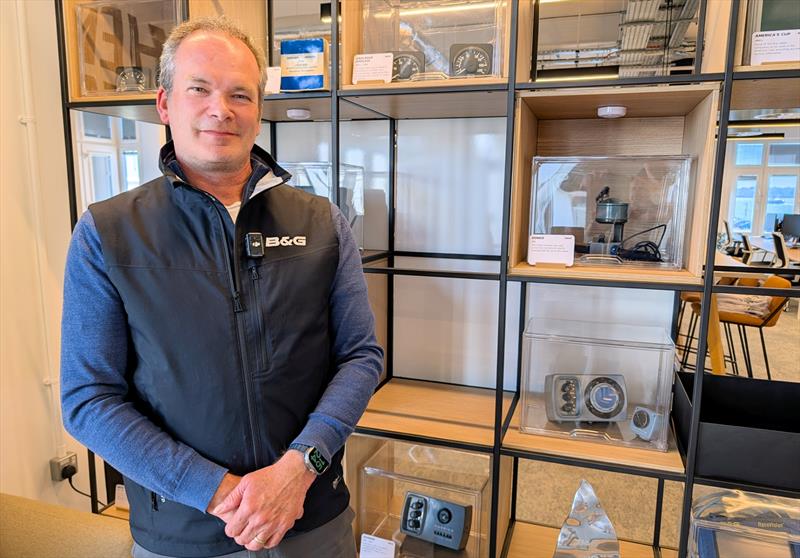
B&G's Matt Eeles with some of the original instruments © Mark Jardine
70 years is a long time for any company, but in marine electronics it's extraordinary. B&G was founded in 1956, and has been a pioneer in the sector ever since.
In an in-depth interview, I spoke with B&G's Matt Eeles, discussing history and evolution of B&G, all the way from the Homer receiver for navigation, through to the present day, and then future developments. We ended with AI-assisted autopilots and continually integrating systems for better safety and efficiency.
B&G's background was in aviation, founded by Major R.N. Gatehouse and Ronald Brookes with the company based in Lymington. They had a military background, but were keen sailors as well, and saw an opportunity to assist with navigation. Their first product was a direction finder - a device on the boat to allow you to hone in on direction signals so that you can plot on a paper chart with some degree of accuracy your estimated position, and subsequently give you a course to steer for. B&G was born with their first device - the Homer.
What is remarkable is that the Homer was essentially an analog device, as Matt describes:
"This is probably the first instance of electronics on boats - there were no transistors. They were using analogue circuitry, which came out of the back end of World War II, with radar technology and VHF technology, so it was cutting edge. There weren't many companies around at that time developing electronics, and particularly for the recreational market, so it was a pretty bold and innovative step to form a company based on electronics for the marine world."
A decade later Sir Francis Chichester set off around the world on Gypsy Moth IV and he used B&G instruments during his solo circumnavigation:
"He had the Homer receiver for dead reckoning to get his estimated position, as well as the Harrier log and speedometer."
It wasn't until 1970 what could be called a computer was developed by B&G, called the Hadrian, which Matt describes:
"The Hadrian took in data from a B&G's first electronic compass - the Hestia - as well as the Harrier log and speedometer, giving you a way of calculating your dead reckoning position based on speed and bearing."
With the Hadrian, the era of marine electronics had truly begun. Race teams were realising the importance of this instrumentation, and in 1974 Ramón Carlin's Sayula II won the first ever Whitbread Round the World Race (now The Ocean Race) fully kitted out with B&G instruments.
The next great milestone was in 1980, with the invention of the Hercules 290, using a microprocessor and an LSI (Large-Scale Integration) chip. This was a major innovation, but there was a fair amount of resistance in racing circles to its usage as Matt explains:
"At this point not even the America's Cup boats had electronics on board, so even at that level teams were struggling with position and calculating true wind, which is what we're still doing today. So, B&G's Hercules calculating accurate speed, heading and wind information was leading edge. I can see why RORC and other organisations wanted to ban it, but as we moved forward, it became more mainstream, and that technology is now expected on every boat."
When it came to offshore racing, and the Whitbread Round the World Race, legendary teams such as Sir Peter Blake's Steinlager 2 and Tracy Edwards' Maiden were equipped with B&G, and in the harsh conditions encountered they demanded the upmost reliability:
"We have always put a huge focus on making equipment that you can trust. When you're in the Southern Ocean and it's pitch black, there's no moonlight, and you can't see beyond the coachroof, what you're relying on is your instruments. Not only for you to be able to see the instruments, but to trust the data. Having that level of trust and reliability in your marine electronics is the number one priority."
When it comes to the utmost tests, the Vendée Globe is the ultimate: sailing solo around the world in a 60 foot yacht where you need to know that everything is working, and will continue to work. Dame Ellen MacArthur used a B&G autopilot for her 2000-21 Vendée Globe campaign, where she finished second, and this is a source of great pride for Matt:
"For me, it was one of my first projects when I started here, working on the wireless remote for the autopilot. One of her requests was being able to go on the foredeck, or even when she had to climb the mast a couple of times, and still to be able to control the autopilot and keep the boat under control. This was one person's request at that level of sailing, and that technology filtered down, and now we all have wireless remotes on our cruising boats."
The next major milestone was integration. Bringing more and more instruments together and networking them, allowing processors to make more and more accurate calculations from multiple sources of data, as Matt explains:
"B&G brought discrete products together as systems: Wind speed, depth, position and all sorts of navigational data were integrated with radar, VHF, AIS and everything else. NMEA 2000 networking has been a great advantage in marine electronics and provided standardisation across manufacturers and products, and by the mid-2000s we saw an acceleration of the technology, through to today where everything works seamlessly together."
Consolidation and integration also took place with the business, when Brunswick acquired B&G, Lowrance and Simrad, creating the Navico Group in 2001 which consists of 18 technology brands, which has had many benefits for the sharing of technology innovations and standardisation of instruments and even how they are fitted:
"More and more products now are on NMEA 2000, not just your basic instruments, but everything from a barometer or air temperature sensor, so you're not wiring in a sensor to an analogue input and trying to calibrate a voltage to a temperature. It also means that a lot of third-party products which don't always work seamlessly together, with the hardware standardised between different Navico brands, become plug and play."
On top of NMEA 2000 we now have Ethernet, which are capable of carrying huge amounts of data thanks to increased bandwidth:
"Ethernet, particularly on larger boats, means there's a full network around the yacht. Generally there's a combination of NMEA 2000, which does have limited bandwidth, and then radar, sonar and IP cameras come through on the Ethernet side."
Talk of the future in the marine electronics world is no different from what we're seeing with the transformative introduction of AI:
"We have to be a bit careful that we don't just use it as a word, that there is actually something behind it. We already use AI for Simrad's AutoCaptain™ Autonomous Boating System, featuring assistance with auto docking, and being able to identify the perimeter of the boat and obstacles. Since Covid we have more people getting into boating who have never owned a boat before, so any way we can make it easier for them is advantageous.
"For a family that is cruising, or on a fast racing yacht, AI can be an extra pair of eyes that can see ahead and potentially identify floating objects, which unfortunately are more common now than they were in the past."
This kind of AI assistance is very welcome in sailing as computers don't get tired and the camera's eyes are always on, using vision in frequency ranges that the human eye cannot see, such as infrared. Collision avoidance systems are good news for everyone on the water.
User interfaces are another area which have come on leaps and bounds in recent years, making control intuitive and accessible for all:
"For six years now we've been very much focused on a redesign of our user interface, particularly on the chart plotters. These products are very complex and get used from a commercial environment down to recreational users who may just be on a yacht charter, so having a user interface where you've got consistency is vital. The user experience and heuristics need to bring what we're all used to with smartphones, into the marine environment, so that everyone should be able to do some basic navigation without having to pick up the manual and or go on a training course. It's been very challenging as it's a complex sport."
I had to ask Matt if there are any projects in development which he's particularly excited about, but it seemed there were so many areas of innovation that he couldn't narrow down just one area:
"Good question! Anything from the computer power of an AI-assisted autopilot, such as we see on the IMOCA yachts and huge trimarans, through to haptic feedback on a fly-by-wire steering wheel. It's going to be quite interesting when that technology filters down to the volume boat builders, because that will start changing boat designs. The mass market cruising yachts currently use two steering wheels at the back of the boat with mechanical linkage. This kind of design could completely change, with a cockpit that's totally different, providing more storage and more entertainment space. For example, with fly-by-wire you could have a helm position at the nav table where you have the same 'feel' as a mechanical steering wheel."
Developing marine electronics, like so much of our lives, is a combination of evolution and revolution, of which B&G has been a pioneer for 70 years, and continues to be at the forefront of. It was fascinating chatting with Matt, seeing the display cabinets at their Southampton offices, proudly showing the company's first products, all the way through to the lab, designing the instruments of the future.
Find out more at www.bandg.com