
Celebrating the Great Race from half a world away
by David Schmidt 30 Dec 2025 16:00 UTC
December 30, 2025
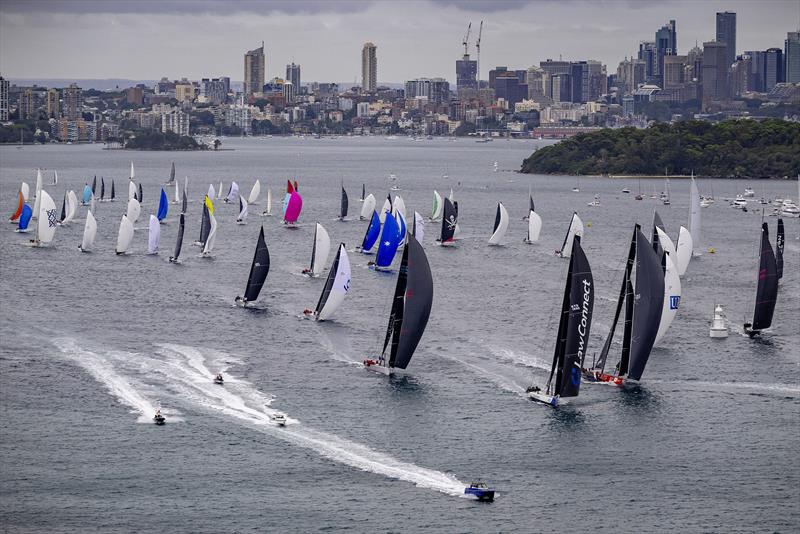
A great deal of the fleet that started the 2025 Rolex Sydney Hobart Yacht Race © Kurt Arrigo / Rolex
Early winter in the Pacific Northwest isn't exactly a great time for sailing. Days are short: Bellingham, Washington, which is located about 25 miles from the Canadian border, only receives 8 hours and 15 minutes of "daylight" on the winter solstice, and these lumens often must first fight their way through an overhead softbox of cloud cover before reaching the city's Vitamin D-starved residents. But, much like Captain Cook and other ship captains learned some basic skills to prevent scurvy before the actual link between tooth loss and Vitamin C was fully understood, PNW sailors also find ways to cope. For me at least, the annual Sydney Hobart Race provides an important opportunity to (vicariously) refill my cup, while keeping me as far removed from the ear-worming (nauseating?) sounds of "The Little Drummer Boy" as possible.
Better still, this year I reeled my family into the Great Race's Boxing Day drama.
For years, I've quietly found reason (opportunity?) to slide away from Christmas Day festivities and retreat with my laptop and headphones to watch the start of this classic 628 nautical mile race. (This is where a -19 time difference between Bellingham and Sydney has long paid handsome dividends.)
This year, however, my father-in-law and I streamed the start on his big-screen TV. I don't think Jimmy Spithill had been commentating for more than three minutes before my wife (a fan of Spithill's since the 2013 days of roosters and feather dusters) joined our watch party, followed by my mother-in-law, who also quickly became engrossed with the unfurling action of the start.
We collectively decided that dinner could wait until the fleet was well past Sydney Heads and the live commentary concluded.
While conditions looked contained in Sydney Harbor, the situation changed rapidly once boats encountered the offshore confluence of the south-flowing East Australia Current, southerly winds, and a developed swell—from the south—that gave the 100-footers an opportunity to air-out the first 20 or 30 feet of their undercarriages every 15 seconds or so.
For the smaller boats, sea state just looked miserable, especially given that PredictWind's models forecasted (correctly) that conditions would increase as daylight eased into the first night watches.
All told, 128 teams began this year's race on Boxing Day, but as of this writing (Monday morning) 34 boats had retired. While this (ballpark) 27 percent attrition rate doesn't compare with 1993, when two-thirds of the fleet was forced to abandon racing, there's no question that the first 36 hours of this year's race presented crews with brutal conditions.
For some teams, this stretched across Bass Strait.
David Gotze, the owner and skipper of No Limit, his R/P 63, described conditions in Bass Strait as "truly horrendous" in official race media.
Fortunately for No Limit and other fast rides, these conditions gave way to great sailing once they reach Tasmania's east coast.
But for some teams, including Grant Wharington's Wild Thing 100, the promise of beautiful sailing never materialized, as the team suffered problems with their runners that threatened their rig and ultimately ended their race.
"When you've got four million dollars' worth of mast in the air, you analyze things a bit more carefully than you once might have," Wharington said in event media.
Given this year's attrition rate, other skippers were clearly conducting similar analyses.
But for some teams that were lucky enough to avoid damage to (wo)man or machine, dividends awaited.
Take Matt Allen and James Mayo, co-skippers of the chartered Master Lock Commanche, who took line honors (2 days, five hours, three minutes, and 56 seconds). While Allen is a three-time Tattersall Cup winner (read: handicap honors), this was his first time reaching the finishing line first. (N.B., Mayo achieved this in 1987, at age 22, when he raced aboard Sovereign, which won both line honors and the Tattersall Cup.)
All told, Master Lock Commanche beat Christian Beck's LawConnect to the barn by 47 minutes and four seconds.
"It's absolutely amazing," Allen said in an official race report, noting that the team had to pull together hard to make this dream a reality, as the two boats were in virtual lockstep for about 100 nautical miles.
While the Master Lock Commanche team reportedly suffered injuries and faced brutal conditions in Bass Strait, followed by light-to-nonexistent airs that threatened their win, they ultimately enjoyed great sailing up the River Derwent, which is the race's final test separating crews from their post-race celebrations.
"The run up the Derwent was the best I've had in 33 races," said Allen in an official race report. "The sailing was superb, and the welcome in Hobart was unbelievable."
While it's too early—as of this writing—to report on the Tattersall Cup winner, a glance at the current standings reveals that many doubled-handed teams are in the running.
I can only imagine that, while fully crewed teams endured their fair share of rough seas and hard uphill conditions this year, the DH teams faced similar tests, but with a heck of a lot less margin for error should one person get injured or wrongly abused by mal de mer.
Sail-World tips our hat to all 128 teams that started this year's Sydney Hobart Race, we have our fingers crossed for the 74 boats that are still racing, and we raise our glasses to all teams that made it—or will eventually make it—up the River Derwent to Hobart (twice for the DH teams).
Finally, Sail-World wishes all readers a happy, healthy, and successful 2026, and we have candles lit that peace may somehow prevail upon our lovely, lonely planet in the New Year.
May the four winds blow you safely home.
David Schmidt
Sail-World.com North American Editor