Jim Young- A Contrast in Hull Forms
by Daniel Johnston on 7 Sep 2010
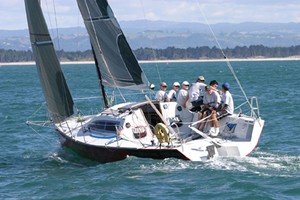
Positive Touch finishes in Tauranga Jim Young
Following an impressive career in the marine industry, one of the great New Zealand designers and boat builders, the legendary Jim Young, has taken the opportunity to provide some insight into the development of the popular Young 11 and Young 88 designs.
In this article Jim examines the transition from the first canting keel boat 'Fiery Cross' through to the modern ultra light displacement boats (ULDB).
Fiery Cross. Not only a New Zealand first but the world's first with a canting keel. Although that distinction hadn't entered my mind. It took another 50 years for the ban on it's use while racing to be relaxed. Fiery Cross was meant firstly for coastal cruising. Fast and with no vices. She never once broached although she broke more than one rudder stock. But that was another learning curve.
Started building in 1945. Launched in 1958. LOA 45ft (13.7m) LWL 41ft (13.5m) Beam 7ft 2in (2.18m) Draft 6ft 4in (1.93m) Disp 4.6 tons SA 550 sq ft (51 sq m) Accommodation 6 berths, galley and toilet. Max disp. hull speed 9 knots. Construction 18mm glued double diagonal kauri on 40 x 22mm stringers on edge. I was building her alone spare time so it was much easier to use short diagonal planking.
The hollow mild steel faired fin had a 2.2 ton lead semi bulb. It was attached to the hull by two massive steel hinges and controlled by a vertical steel tube with a bearing at the deckhead. The tube was joined to a 100mm diameter stainless steel shaft that passed down through a 100mm diameter gland. The shaft was then bent aft to the 22.5 degree Max. When heeled at 22.5 degree and the keel canted to the maximum it was at 45 degrees.
The extra speed generated meant the fin retained it's resistance to leeway even at an angle so there was no need for the additional retractable fins as they do now with keels canted by hydraulics to windward so far that they are close to horizontal when at maximum power. Just like aircraft and birds the faster you go the smaller the wings.
Mr Herreschoff wrote as very encouraging letter after seeing a photo of her in Sea Spray. (although he said he thought the front of the lead bulb was a little blunt and the front of the cabin would have been better pointed.' 'To part the waves!'
Besides the canting keel I think Fiery Cross was also the first laminated glued hull to be built in New Zealand (and possibly the world as well) using the new reliable Resorcinol Urea. (although Ariel a modified Scandinavian 30 square metre built by Jim Lidgard at Bayswater was the first to be launched)
The first YOUNG 11 was Honeywell, built by my brother Alan for Ross Field. Ross had the first Young 88 Paddy Wagon (Ross was then a cop). Roger Land saw the Young 11 as a logical step up from the Young 88 and Honeywell became the plug for the fibreglass moulds. With her beamy, dinghy type lines with flared sides Honeywell could hardly differ more from Fiery Cross.
I don't know of any boats with that hull form before 1980 but now they appear the most common hull form. In fact I wrote a piece published in Sea Spray in 1980 suggesting two designs of that hull form as ideal to exploit the spectacular weight savings with added strength in the new light weight structural system. Unidirectional glass laid over both faces of a strip planked core.
The Young 88 and then radical Rocket 31 were ideal for the new technology which offered great strength with spectacular saving in weight. It is now popularly known as Cedar Core construction. The Y88 plug was built by Greg Elliott and the Rocket 31 was built by Terry Cookson. They were the first yachts to be built using the technology. The first powerboat was the Vindex 40 built by Peter Sowman in 1981. Later to become the Formula 4000.
Camp Freddie, a Rocket 31 built and sailed by Greg Peck in the UK won every regatta she entered. She was the overall winner of Class One Cowes week in the UK in 1994. In strong winds. Her slightly lower spec. sister Zapata won Class Two. Camp Freddie then went on to win the Round Isle of Wight race against 1800 starters. The only New Zealand design to make such a coupe. Yet the local yachting press didn't even notice!
The concept of the light, dinghy type, high performance keel yacht had never been seen in the Northern Hemisphere. Nor had it been seen in New Zealand before 1980. I believe it was the astounding performance of Camp Freddie (one UK yachting scribe describing her as looking like a squashed jandal) that inspired the now globally popular production sports yacht.
Recently my grandson Aaron Young owned and sailed Positive Touch, the first R31 and built by Terry Cookson in 12mm strip kahikatea in 1982 for Laurie and Jim Kean. She had 10oz. Of unidirectional glass cloth on the inner and outer faces of outer faces of the 12mm core. Aaron added the latest fin and a new rig and spent a season in this now thirty year old design cleaning up the latest and best. Positive Touch, to my sorrow, is now based in New Caledonia along with a number of YOUNG 11s. 'Salt water's been made of the same stuff since long before Noah. Once a good boat always a good boat'. but none so precious as 50 year old Fiery Cross!
Force 11, a Young 11 helmed by Jim's grandson Aaron Young, recently won Division 2 at the Royal New Zealand Yacht Squadron (RNZYS)
Reference: http://www.mshipco.com/pdf/SailingWorld_CBTF_Sep2008.pdf 'Fiery Cross was the world's first canting keel boat' Stuart Streuli
If you want to link to this article then please use this URL: fishingboating.world/74397